When it comes to the UK’s online property portals, Rightmove is the 800-pound gorilla, with around 80% of all the time spent on property portals being spent on Rightmove.co.uk.
That makes it the default choice for home hunters and estate agents, and that’s an enviable position for any business to be in.
The strength of Rightmove’s position has fuelled a lot of growth since the company was founded in 2000, and Rightmove is, quite rightly, generally thought of as a growth stock rather than an income stock.
But it does pay a dividend, and it has grown that dividend in almost every one of the last 20 years, so I do think Rightmove is worthy of consideration by dividend investors. In fact, I think Rightmove could be one of the best dividend stocks in the UK, at least for some investors.
Rightmove’s financial track record is spectacular
Let’s start with Rightmove’s dividend track record. As the table below shows, it isn’t perfect, but it does have one of the most impressive dividend histories of any UK-listed company.
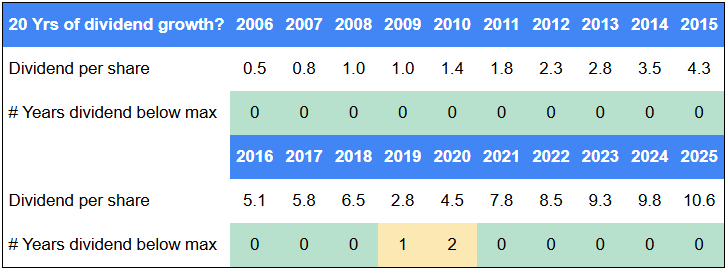
The amber cells highlight dividend cuts and how long they lasted. Rightmove’s only dividend cut occurred in the 2019 financial year, courtesy of the pandemic, but it was a short-lived affair and within two years the dividend was setting new all-time highs.
Rightmove only joined the London Stock Exchange in 2006, so the table above covers its entire history as a listed business. As a relatively young firm, Rightmove grew its dividend at an average rate of 25% between 2006 and 2015. By 2016 the company was much larger, so its growth rate had slowed, and over the last ten years the dividend has grown at a less hectic but still impressive 8% per year, on average.
Of course, dividends cannot grow indefinitely without supporting growth across earnings, revenues and shareholder equity, so it’s good to see that Rightmove has generated broad growth across each of those metrics.
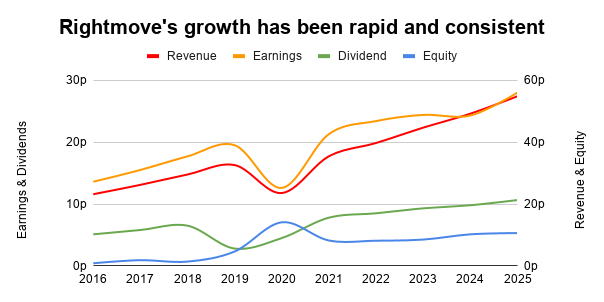
Just as impressively, almost all of Rightmove’s growth has been funded by retained earnings rather than debt, leaving the business with an almost debt-free balance sheet.
How has Rightmove managed to fund a near-10% growth rate using retained earnings alone? The answer is that it generates spectacularly high net returns on capital, so it’s able to fund rapid growth while also paying out substantial dividends and buybacks.
I like to think of this as being analogous to a savings account. If a savings account has a 5% interest rate (a 5% return on capital), the money in the account can only grow by 5% per year, even if you retain all of the interest within the account. But if a savings account has a 100% interest rate (which is obviously unlikely), you could withdraw almost all of that income each year as a “dividend” yet still retain enough to grow the account (and therefore the future income) by 10% or more each year.
In Rightmove’s case, its net returns on capital are, quite frankly, astonishing.
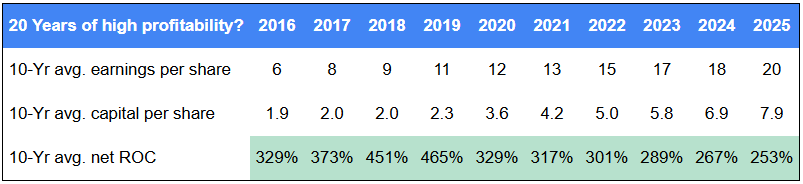
The table above shows the ten-year rolling averages for Rightmove’s earnings, capital (equity + debt) and net returns on capital. For the most recent ten-year period (to 2025), the average net return on capital was 253%. To put that in context, most companies struggle to generate a net return on capital of 10%.
Rightmove’s triple-digit profitability is exceptional, and it is clear evidence that the company has an extremely powerful and enduring competitive advantage.
A crushingly dominant virtual monopoly
So how has Rightmove managed to generate such extraordinarily high profits over more than two decades, when economic theory tells us that competition should quickly erode excess profits?
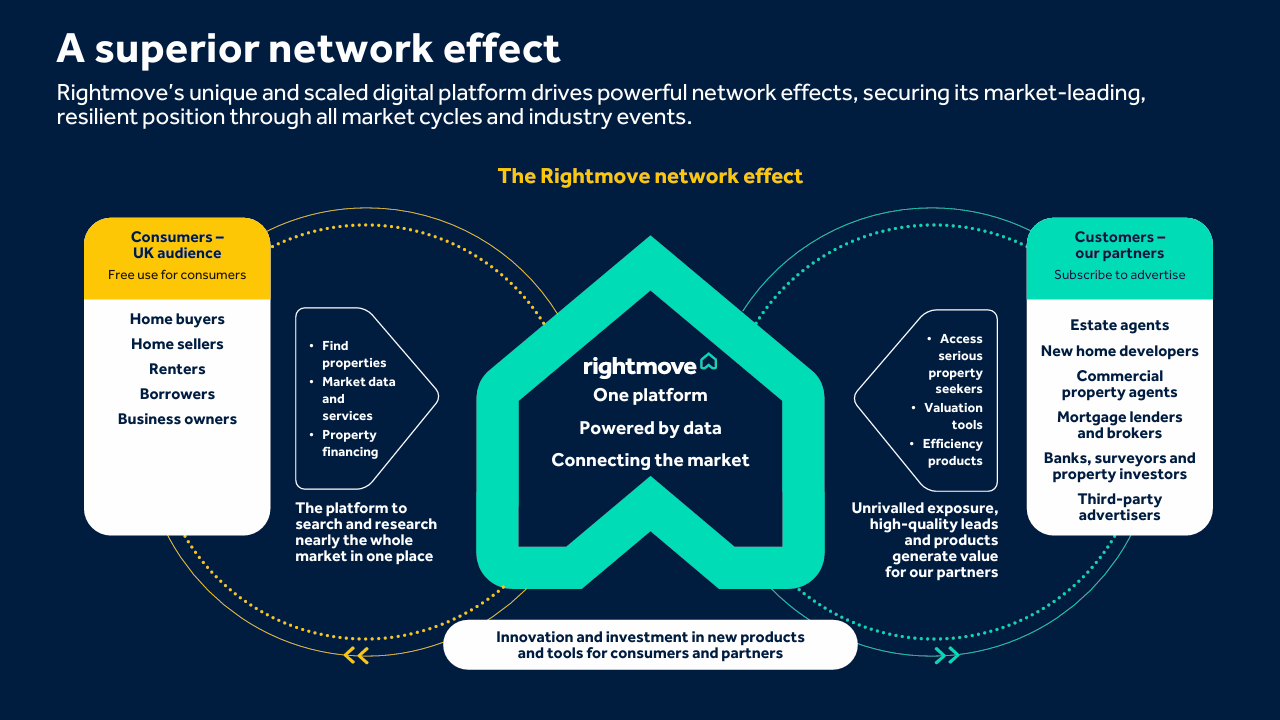
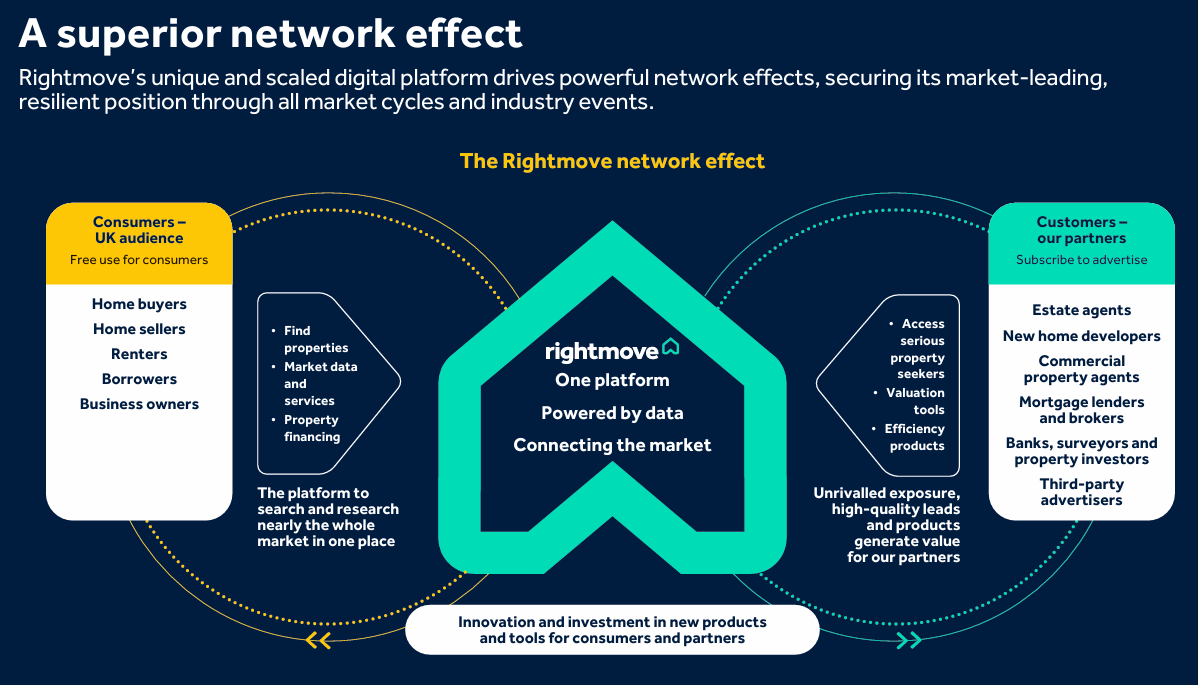
The answer is that Rightmove benefits from powerful feedback loops (known as network effects) that make its position as the UK’s leading online property portal virtually unassailable.
In a nutshell, Rightmove brings together the two sides of the UK property market, which means individuals (as buyers and renters) and estate agents (acting for the seller or landlord).
The powerful feedback loops arise from the fact that sellers usually want to sell in the largest marketplace with the most buyers, and buyers usually want to buy from the largest marketplace where they’ll find the most sellers and the most choice.
If a marketplace can gain enough of a scale advantage over its competitors, it becomes the default choice for almost all sellers and buyers, at which point its position of dominance becomes incredibly hard for competitors to break. This is the “winner takes all” business model that underpins the success of platforms like Facebook, eBay and Amazon, and it also underpins Rightmove’s success.
While there are many benefits to being a crushingly dominant virtual monopoly, there are downsides as well. One recurring downside is that virtual monopolies often rely too heavily on squeezing every penny out of their core customers. They do this because they run out of market share to take, and the next easiest way to grow profits is to raise prices or find some other way to squeeze customers that have little choice but to use the virtual monopoly’s platform.
Social media platforms like Facebook are the poster child for this strategy, where the goal is to get users to spend every second of their lives looking at ads on the platform, regardless of the damage this does to the user's mental health. This can work for a long time, but eventually it undermines the viability of the business, as Facebook is finding out.
In Rightmove’s case, many estate agents have long argued that its pricing policy is too aggressive, to the point where a £1.5 billion lawsuit has now been filed against the company for abusing its position of power.
It may be a coincidence, but Rightmove has recently embarked upon a new growth strategy where estate agents don’t have to be held upside down and shaken until every penny falls from their pockets.
Growing beyond the core property listings business
Rightmove is primarily a property listings business, and fees from listings still generate the majority of its revenues. However, over the years, it has added additional products like on-site ads for estate agents, banks and others, as well as various services and tools to help estate agents run their businesses more efficiently and effectively (including training, lead generation, price and inventory optimisation and numerous property market reports).
In many cases, these services have the useful side effect (or perhaps the primary purpose) of embedding Rightmove’s software and tools deep within the daily workings of its customers’ businesses. This makes it harder for customers to switch away from Rightmove, and this is another common tactic used by many of the big network-effect platforms (Facebook is again the classic example).
Even better, if Rightmove can use its scale to help estate agents be more efficient than their competitors, then (a) those agents will have more cash available to spend on Rightmove’s “featured property” listings and other premium services, and (b) estate agents who aren’t using Rightmove’s efficiency tools will feel compelled to use them, otherwise they’ll be driven out of business by those that do.
Strategically, expanding beyond the core property listings business is a no-brainer, so when a new CEO arrived in 2023, it wasn’t surprising to see him step on the gas pedal. In fact, he gave Rightmove the expanded goal of becoming “the leading digital property market ecosystem for the entire moving experience”.
The table below neatly sums up the vertical and horizontal expansion opportunities that Rightmove now has its eyes on, as it seeks to provide a seamless end-to-end service for the entire property market.
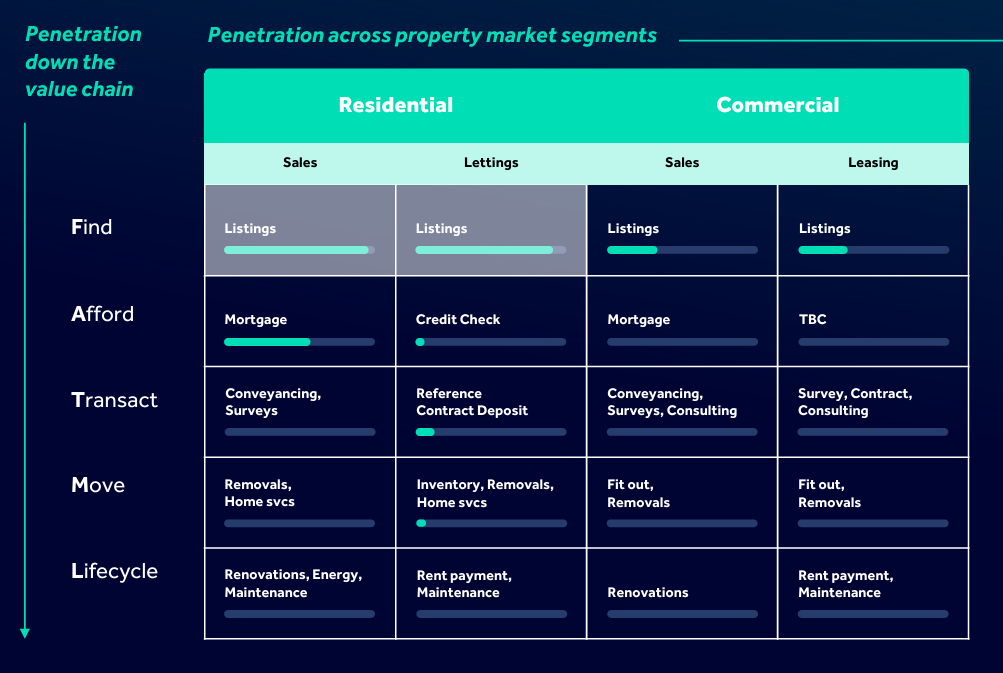
Currently, Rightmove dominates residential property listings, but almost everywhere else is virgin territory. However, trying to expand everywhere all at once would be a terrible idea, so the matrix below shows the limited number of areas Rightmove will focus on over the medium term.

This more ambitious approach to expanding beyond the core only began in 2023, so it’s still early days, but some changes are beginning to show up. For example:
Mortgage in Principle: In the financial services space, Rightmove has added a mortgage in principle service, currently in partnership with NatWest. This gives users a good idea of how much they’ll be able to borrow, while generating some nice commission income for Rightmove as well.
Lead to Keys: This is a suite of rental services products to help letting agents manage the process of renting properties, from accepting holding deposits to referencing tenants and getting contracts signed, all while minimising the risks of regulatory non-compliance.
Angry customers, new competitors and the threat of AI annihilation
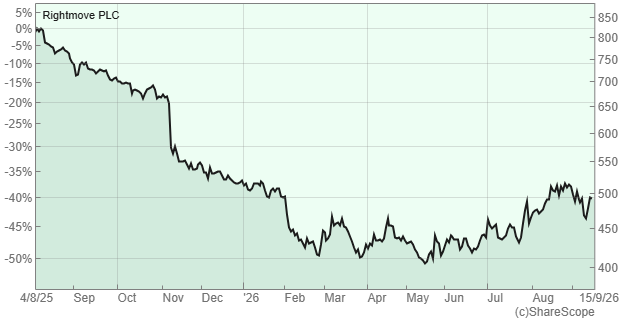
Rightmove may well be a virtual monopoly, but its share price has still fallen by about 40% over the last year. There are various reasons why, but three stand out.
First, the aforementioned £1.5 billion lawsuit. I won’t even begin to estimate the odds that the lawsuit will be successful, or to what extent Rightmove might settle to make it go away, but a £1.5 billion payout would be almost equal to all of Rightmove’s profit over the last ten years, and it’s more than enough to kill the company.
Second, we have the acquisition of On The Market by CoStar. CoStar is a US-based owner of multiple property platforms, and it’s looking to use On The Market (the UK’s third-largest property portal) to expand into and eventually dominate the UK market.
Third, we have AI. Some investors are worried that Rightmove will be disintermediated by AI, if home hunters turn to AI platforms rather than property platforms to find their next home.
Although each of these threats is real and not to be taken lightly, none of them would stop me from investing in Rightmove.
The lawsuit, for example, is a known unknown, but the degree of uncertainty is enormous. And so, like the ever-present threat of a nuclear war, this is a risk I would monitor, but until we get more clarity, it wouldn’t affect my investment decision.
As for CoStar, I see it as just another competitor. Yes, it’s a far bigger company than Rightmove and with far deeper pockets, but Rightmove has by far the largest audience and property listings, and that is an almost priceless asset. That doesn’t mean Rightmove is guaranteed to prevail, because it might not, but it does mean Rightmove is well placed to beat the competition, including CoStar.
Last but not least, we have AI. As the leading property data platform in the UK, Rightmove owns far more UK-specific data than its peers, and that puts it in a very strong position to leverage AI (which is nothing without lots of good data) more effectively than its peers. In other words, I think Rightmove is more likely to be an AI winner than an AI loser.
The dividend yield is low, but the valuation is still attractive
With its shares trading at £4.90, Rightmove has a relatively low dividend yield of 2.2%. That’s below the FTSE 100’s 3.1% (with the FTSE 100 at 10,700), so if you’re a hardcore high-yield investor, Rightmove probably won’t interest you.
However, if you’re primarily interested in having a high-yield portfolio, rather than exclusively holding high-yield stocks, then you might be willing to have Rightmove in your portfolio, as long as your portfolio’s overall yield is above the FTSE 100 or FTSE All-Share yield.
Personally, I used to stick exclusively to high-yield stocks, but given that the UK stock market is shrinking, and many companies are holding back dividend growth to fund buybacks, I’m now willing to invest in lower-yielding stocks. That is, as long as the overall valuation still makes sense and as long as the overall yield on my UK Dividend Stocks Portfolio is still high.
What do I mean by an attractive “overall valuation”? I mean the share price must be trading at a significant discount to the stock’s estimated fair value. There are various ways to assess “fair value”; my approach is to estimate (a) the company’s dividend growth over the next ten years, and (b) a conservative PE at which I might be able to sell the shares at the end of that period.
The output of all that is a discounted dividend model, and you can see Rightmove’s dividend model below.
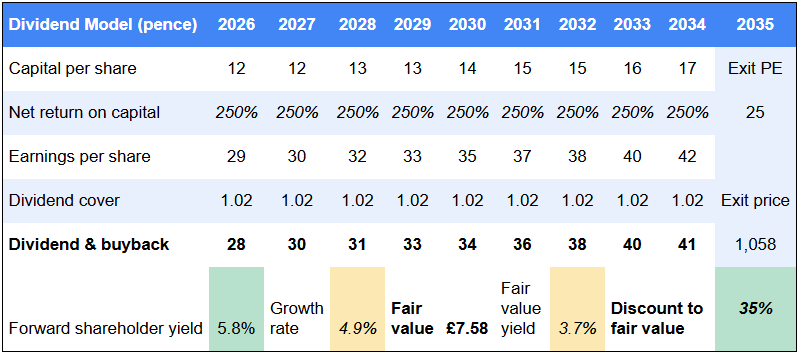
In simple terms, the model assumes that Rightmove:
- Continues to earn its historically average return on capital (250%)
- Keeps dividend cover at a historically average 1.02, which retains enough earnings to fund a historically conservative growth rate of 5%
- Pays out a historically average amount of cash as dividends and buybacks, totalling 28.3p in 2026, which matches the actual payout from dividends (10.6p) and buybacks (18.2p) in 2025
- Is sold in 2035 at a historically average PE of 25, giving an exit price of £10.58
The net result of all that is a fair value estimate of £7.58, versus today’s share price of £4.90.
As a sanity check, I always make sure the “fair value yield” is above 3%. The fair value yield tells us what the yield would be from this year’s estimated dividends and buybacks (28.3p), if the shares were trading at my fair value estimate of £10.58. If the fair value yield is below 3%, there’s a good chance the exit PE is too high, and my fair value estimate is far too optimistic. That isn’t the case here, as the fair value yield is a reasonably sensible 3.7%.
With a fair value estimate of £7.58 and a current share price of £4.90, there is a sizable 35% discount to fair value, which is good news. In fact, it’s very good news as my minimum discount is 25%, so Rightmove’s share price is low enough for me to want to invest.
A virtual monopoly with a fantastic track record, room to grow and an attractive share price
In summary, I think Rightmove has:
- A fantastic track record of progressive dividend growth and high profitability with little debt
- Powerful network effects that give it a durable competitive advantage and a monopoly-like position
- Room to expand vertically and horizontally into closely related products and services
- An attractive share price, as a result of various headwinds that have led some investors to sell
As with any attractively valued stock, there are issues that need to be dealt with (notably the lawsuit, CoStar and AI). If there weren’t, investors would be happy, the share price would be much higher, and the valuation wouldn’t be attractive.
But, in this case, I think Rightmove’s strengths outweigh its weaknesses. Does that make Rightmove the UK’s best dividend stock? I don’t know about that, but it’s certainly close, and I think there’s a good chance Rightmove will be added to the UK Dividend Stocks Portfolio before the end of the year.
No time for spreadsheets or annual reports?
If you like this article but don’t have hours each month to dig through company accounts, you might find my monthly investment newsletter useful.
Once a month I send out a plain‑English PDF showing:
- The full UK dividend stocks model portfolio
- Which shares I’m buying, selling, trimming or topping up
- The latest news and trading updates for each holding
- Where we are in the stock market valuation cycle
All designed so a UK investor can stay on top of their dividend portfolio in well under an hour a month.
Get the latest blog posts & a free checklist
Get my latest articles in (at most) one email per week and download my dividend investing checklist. Topics usually include:
- Detailed reviews of high-quality UK dividend stocks
- Updates on my UK dividend stocks portfolio
- FTSE 100 and FTSE 250 valuations
- "How to" articles covering all aspects of dividend investing
No spam. Unsubscribe anytime.