I haven’t published a review of the UK Dividend Stocks Portfolio since the end of 2024, so there’s a fair bit to catch up on.
The most obvious point to mention is that the portfolio has materially underperformed the FTSE All-Share since the last review, so in this latest review I’ll mostly focus on why that is, and why I don’t think the various causes should be an issue going forwards.
After that, I’ll walk through all of my recent buy and sell trades, and I’ll wrap up with why I’m more optimistic about UK stocks than most of the investors I speak to.
Dividend yield: Significantly higher than the FTSE All-Share’s
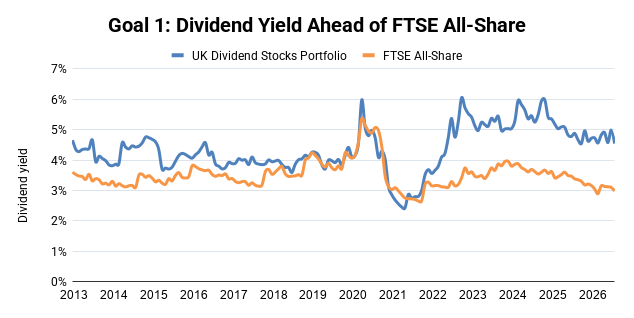
As a reminder, before the pandemic the portfolio and this website operated under the UK Value Investor label, so although dividends were a key part of my investment style, I wasn’t specifically looking for high-yield stocks. That changed in 2021 when I started focusing explicitly on UK dividend stocks, and the chart above shows the resulting impact on the portfolio’s dividend yield.
Since 2021, the portfolio’s yield has consistently been one to two percentage points higher than the All-Share’s, and that remains the case today, as the portfolio’s yield is currently 4.5% versus 3.0% for the All-Share (at the end of July).
This is good news, as I very much enjoy seeing a fresh batch of dividends land in the portfolio's cash account each month. However, before I pat myself on the back too much, I should point out that maintaining a high yield is the easiest of the portfolio’s goals. When it comes to the goal of outperforming the FTSE All-Share on a total return basis, the news isn’t quite so good.
Total return: Behind the All-Share since late 2024, but I expect that to change
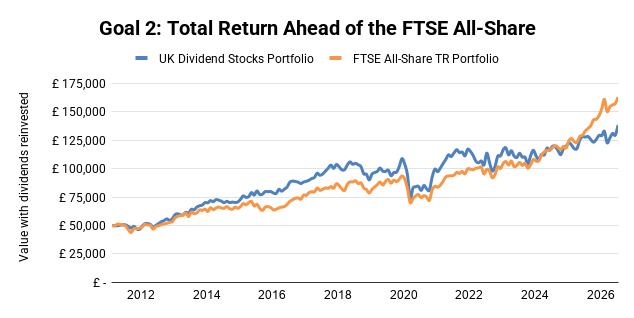
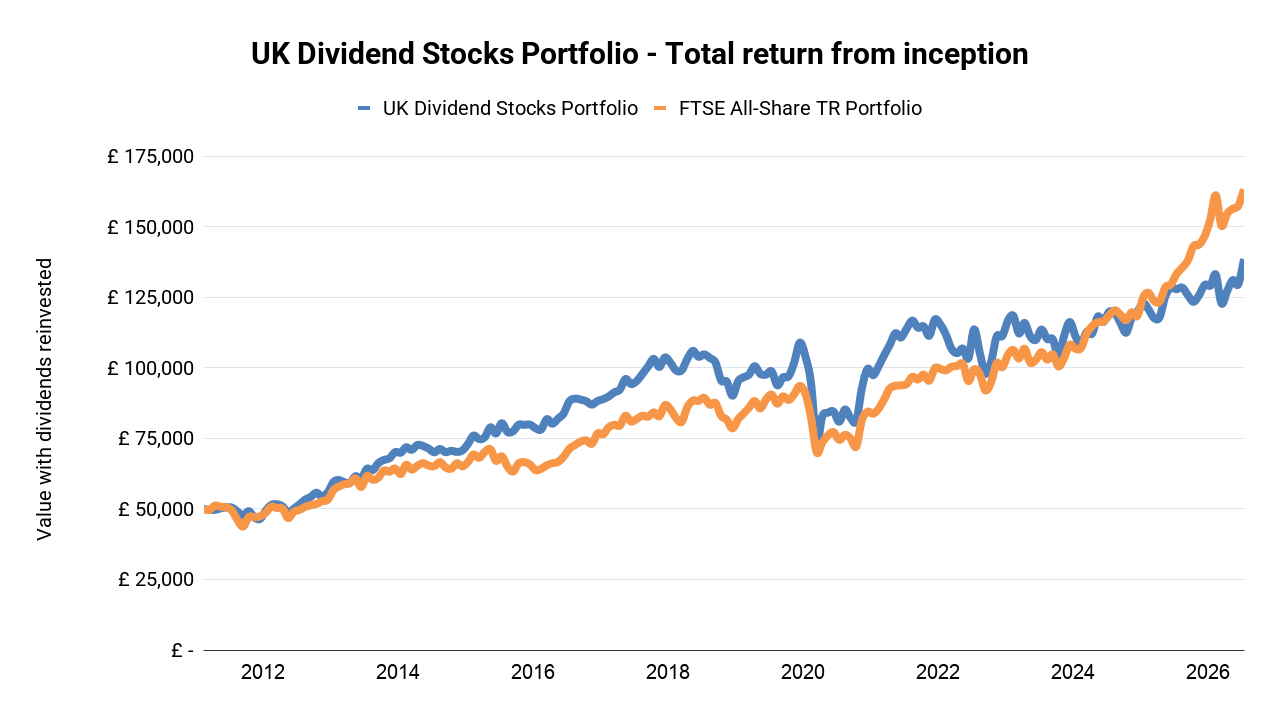
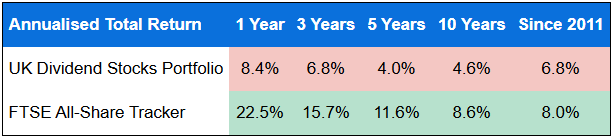
The FTSE All-Share's recent strength has left my portfolio in the dust, and it now lags behind the All-Share on a total return basis over 1, 3, 5 and 10 years, and from inception.
That sounds pretty abysmal, and it certainly is very frustrating, but as the long-term chart above shows, the portfolio was ahead of the All-Share from its inception in 2011 until as recently as 2024. On that basis, I think the portfolio's recent underperformance is a short-term issue, caused by four temporary headwinds that shouldn't have a long-term impact.
Headwind 1: Damage caused to lower-quality holdings by the pandemic
Before 2020, the portfolio and this website operated under the UK Value Investor label, and I was more willing to invest in mediocre companies as long as the valuation looked attractive. Even before the pandemic some of these holdings had started to struggle, and when the pandemic struck it was almost a knock-out blow for several of them.
My response was to reposition the portfolio exclusively towards high-quality companies. That process has taken several years, and selling the portfolio’s lower-quality holdings at depressed prices has been a headwind for quite a while, but the task is now largely complete, and this shouldn’t be an issue for future returns.
Headwind 2: Trying an active position-sizing strategy
In 2021, I started using an active position-sizing strategy, where the portfolio’s most attractively valued holdings would be given the largest position sizes.
In theory that sounds great, and some high-profile investors have used this concept successfully, but in my case, it was a flop. I ended up doubling down on holdings where the share price had fallen furthest, and this left the portfolio over-invested in companies that turned out to be less exceptional than I’d thought.
I think this was a useful experiment, but by the end of 2023 I’d switched back to a simple equal-weighted position-sizing strategy. In other words, positions have a fixed target size (currently 5% as the portfolio aims to hold around 20 stocks), and they're only trimmed or topped up if they stray too far from that target. This approach is much simpler and leads to far fewer trim and top-up trades, and it's still the approach I use today.
The net result of this active-sizing experiment was a couple of years of excessive trimming and topping up, and some overinvestment in subpar holdings, but this is fundamentally a legacy issue that shouldn’t affect future returns.
Headwind 3: Switching to discounted dividend models
In early 2021, I started valuing stocks with discounted dividend models. Before that, I’d always used ratios like PE10, PD10 and dividend yield, as well as how high a stock ranked on my investment newsletter's stock screen. However, discounted dividend models are the more theoretically correct approach, and I’m also a theoretical kind of chap, so I found the idea of building these models both intellectually and practically compelling.
More than five years later, I still use discounted dividend models to value stocks, but it did take a couple of years or so to build up a reasonable level of competence, especially in terms of how conservative the underlying assumptions should generally be. That learning curve was also a headwind as it occasionally meant I overpaid for some holdings, but, once again, this is a legacy issue that shouldn’t affect future returns.
Headwind 4: The FTSE All-Share's exceptional recent performance
About 85% of the portfolio’s benchmark (a FTSE All-Share tracker) is invested in the FTSE 100, so the two are almost interchangeable. This matters, because the FTSE 100 has gone up by more than 60% on a total return basis since late 2023, and that performance is nothing short of spectacular.
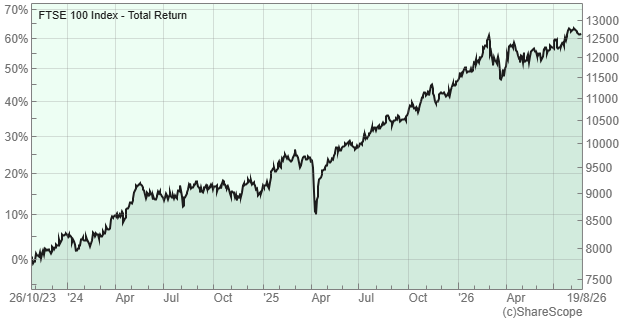
Chart by ShareScope
This is fantastic news, because the FTSE 100 has long been a laughing stock, derided as the Jurassic Park of stock market indices. But now, it seems that this particular dinosaur is roaring back to life, and that’s great because it will attract the attention of mainstream UK investors who have, for far too long, focused almost exclusively on global indices and US tech stocks.
The downside of this spectacular performance is that it was mostly concentrated in large-cap stocks, so if you weren’t heavily exposed to those stocks, you likely underperformed. The UK Dividend Stocks portfolio only has a 35% weighting to FTSE 100 stocks, so from that point of view it has missed out.
However, in the world of investing, you have to learn to take these things on the chin. Sometimes the stock you bought goes down 50%, and sometimes the stock you almost bought (but didn’t) receives a takeover offer and goes up by 80% in a day. Sometimes the index you’re benchmarked against goes down 20% while your portfolio goes up 20%, and you look (temporarily) like a genius. And sometimes your portfolio goes nowhere for a couple of years while your benchmark goes up by 60%, and you look (temporarily) like an idiot. It’s annoying, it’s frustrating, but it’s the nature of the beast.
Dividend growth: Buybacks have become a short-term problem
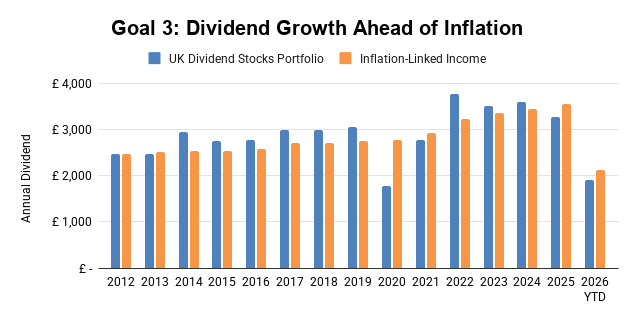
Inflation-beating dividend growth is the portfolio’s third and final performance metric. There usually isn’t much to say here, as the portfolio’s dividend has usually grown at a very similar rate to inflation (this is dividend growth on a drawdown basis, i.e. with dividends not reinvested).
That is beginning to change though, as many companies are restricting their dividend growth, or even resorting to dividend cuts, in order to launch or increase their buyback schemes. To a large extent, this is due to pressure from institutional shareholders, and I have mixed feelings about this.
From an institutional shareholder perspective, I can understand why they like buybacks. The US has been the buyback capital of the world for decades, and those buybacks have resulted in faster earnings and dividend growth for the S&P 500. That growth has attracted wave after wave of investors, and that demand has pushed the S&P 500’s price and valuation to extreme levels. The net result is very high share prices for US stocks and very large bonuses for corporate executives and fund managers. They want to see the same dynamic in the UK, and I can’t blame them for that.
But as a dividend investor, it pains me to see companies cut their dividend, or restrain its growth, in order to fund new or enlarged buyback programmes. Ultimately, I have no control over this so it isn’t something I’m going to lose sleep over, but it has held back the portfolio’s dividend growth over the last year or two, and that is likely to continue for a while yet.
For example, Legal & General (a holding since 2017) has committed to only raising its dividend by 2% for the next few years, even though earnings growth is closer to 10%, with much of the difference being used to fund a growing buyback scheme.
This trend could see the portfolio’s dividend growth rate fall behind inflation for a few years. However, once the dividend/buyback ratio stabilises, those buybacks will boost per-share earnings and dividend growth, at which point dividend growth should exceed inflation once again, and by a larger margin than before.
Purchases, sales, trims and top-ups
I try to follow Terry Smith’s mantra of buying good companies, not overpaying, and doing (almost) nothing, so I’ve only made a few changes to the portfolio since the 2024 year-end review.
In February 2025, I added Croda International to the portfolio. Croda makes the “magic ingredients” that Unilever (another holding) and others put into their beauty and home products, to give them marketable and science-based properties. Croda has the kind of stable track record I’m looking for, and its vertical and horizontal integration seem to give it a competitive edge, so it's a good fit with my quality-dividend approach.
In June 2025, I sold Direct Line (the insurer) after an unpleasantly dramatic three-year holding period. Direct Line was a low-quality company that wouldn’t pass my investment checklist today, but when it joined the portfolio in 2022, I hadn’t completed my transition to quality-dividend investing, so my standards were lower. In the end, a takeover offer from Aviva meant the investment wasn’t a disaster (the total return came in at a just-about-acceptable 6.6%), but it wasn’t an experience I’d like to repeat.
In October 2025, I sold Senior (a manufacturer of thermal and fluid conveyance systems) after the company failed to bounce back from a series of setbacks, including the 2019 grounding of Boeing’s 737 MAX aircraft and the pandemic.
Senior joined the portfolio in 2019, and like Direct Line, it effectively became a legacy holding after I began tilting the portfolio towards higher-quality companies from 2021. Senior’s weak (sub-10%) returns on capital, stretching back to 2016, would have barred it from the portfolio under my current investment checklist, but I did manage to top the position up when the share price was particularly low, and that gave the investment an annualised total return of just under 7%.
In February 2026, I sold WPP, one of the world’s largest advertising and marketing agencies. Like Direct Line and Senior, this was another subpar legacy holding that I removed as part of the portfolio’s now largely complete transition to higher-quality companies.
WPP’s main problem was the fact that most of its growth had come from a long series of debt-fuelled acquisitions. That's a dangerous strategy because it often produces companies that are little more than complex networks of mediocre businesses, balanced precariously on top of an unsustainable mountain of debt. Buying WPP was an avoidable mistake, and it made a small loss over its six-year holding period.
In June, I reluctantly sold Schroders after the company received an attractive takeover offer. Unlike Direct Line, Senior and WPP, Schroders was a long-standing holding that did meet the elevated quality standards I’ve used in recent years.
Schroders was also one of my favourite holdings, because its management was willing and able to focus on the long-term sustainability of the business, rather than obsessing over quarterly results as so many other companies do. That unusual and valuable trait was supported by the founding family’s controlling stake, so it will be interesting to see how Schroders performs over the coming decades without that bedrock of support from a multi-generational family owner.
In July I added 4imprint to the portfolio. 4imprint is the leading US promotional products distributor, selling t-shirts, hats, mugs and more, emblazoned with the logos of small businesses who want to promote their businesses by giving these products to staff, customers and prospects. 4imprint has the kind of consistently strong profitability and growth that I’m looking for, and it seems to have at least one durable competitive advantage, so hopefully it will remain in the portfolio for many years.
A concentrated portfolio of quality dividend stocks
As you can see from the list of trades above, I have been selling more holdings than I’ve been buying, so of course the number of holdings has reduced. This is deliberate, as I’ve gradually reduced the target number of holdings from 30 pre-pandemic to 25 and then to 20, and the portfolio currently has 22 holdings.
A target of 20 holdings is quite low, at least relative to most of the investment funds and trusts that individuals can invest in. With so few holdings, there is a risk that the portfolio could be too concentrated, where the demise of a single holding could blow an enormous hole through the portfolio.
To offset that risk, the portfolio is approximately equally weighted, with a target position size of 5% and rebalancing triggers set at 3% and 7%. In other words, if a position falls below 3% it should either be topped up to 5% or sold, and if a position grows beyond 7% it should either be trimmed back to 5% or sold.
Currently, the largest holding (Admiral, the insurer) is sitting right on that 7% limit, so a trim is very much on the cards. At the other end of the spectrum, there are two holdings materially smaller than 3%, where operational problems have led to serious share price declines. Both of these holdings are sell candidates, and there’s a good chance that one or both of them will be sold before the end of the year.
Looking to the future: Attractive valuations and an improving business environment
In my recent FTSE 100 review, I pointed out that the index was still trading at a very reasonable price, even after 2025's exceptional capital gains. In my opinion, the UK Dividend Stocks portfolio has an even more attractive price, which shows up most notably in its high yield of 4.5%, versus the FTSE 100’s 3% yield. And so, from a valuation perspective, I’m happy with where things are today.
As for growth, I don’t have a crystal ball, but the current business environment is the most normal I’ve seen since 2019. Yes, the world still isn’t perfect (and never will be), but most of the annual results and trading updates I’ve read over the last year or so have been cautiously positive, with low- to mid-single-digit growth almost the norm. That makes a welcome change from the trials and tribulations and pervasive sense of doom we've had for most of the last six years.
Perhaps, at long last, the pandemic’s aftershocks have almost entirely faded into history, and we can get back to the enjoyable task of investing in a UK stock market where optimism and growth propel each other forward in a virtuous circle.
No time for spreadsheets or annual reports?
If you like this article but don’t have hours each month to dig through company accounts, you might find my monthly investment newsletter useful.
Once a month I send out a plain‑English PDF showing:
- The full UK dividend stocks model portfolio
- Which shares I’m buying, selling, trimming or topping up
- The latest news and trading updates for each holding
- Where we are in the stock market valuation cycle
All designed so a UK investor can stay on top of their dividend portfolio in well under an hour a month.
Get the latest blog posts & a free checklist
Get my latest articles in (at most) one email per week and download my dividend investing checklist. Topics usually include:
- Detailed reviews of high-quality UK dividend stocks
- Updates on my UK dividend stocks portfolio
- FTSE 100 and FTSE 250 valuations
- "How to" articles covering all aspects of dividend investing
No spam. Unsubscribe anytime.