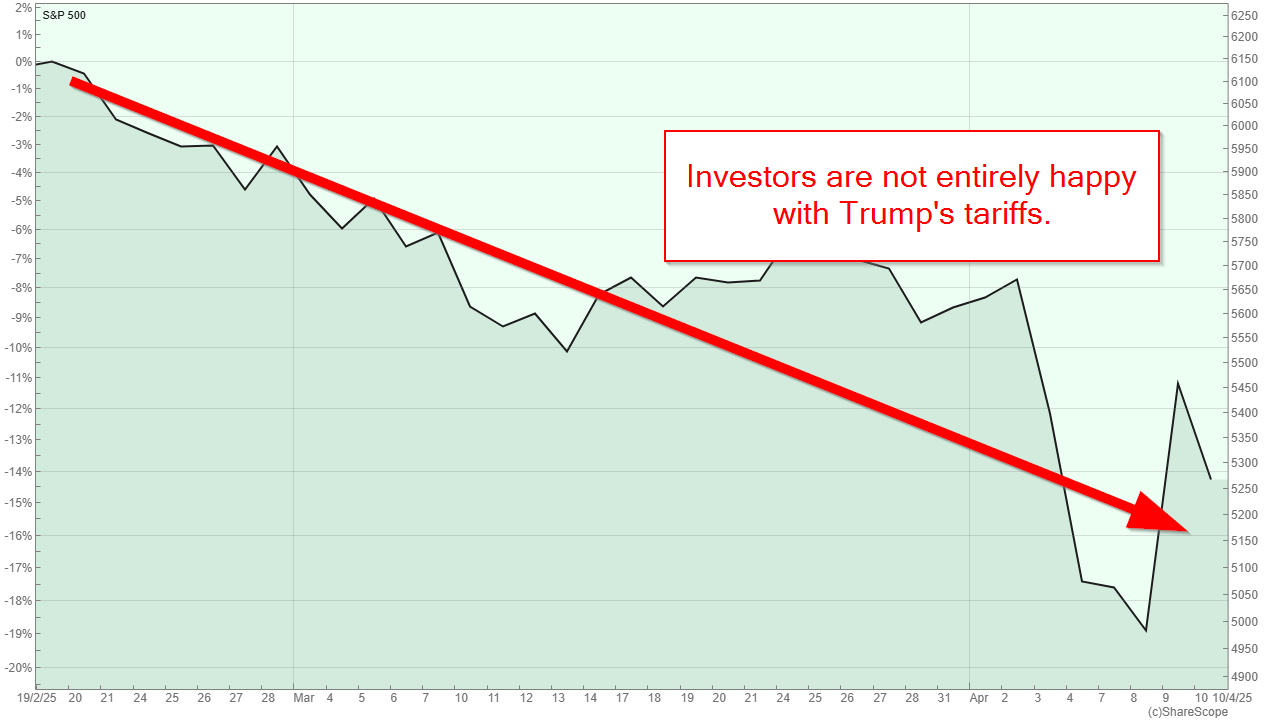
Somewhat reluctantly, I'm going to say a few words about Mr Trump and his tariffs.
I say "reluctantly", because long-term investors should be focused on the long-term, and that means not worrying too much about what happens, economically or geopolitically, on a daily, weekly or even monthly basis. In the long-run, these things rarely have any meaningful impact, and when there is a meaningful impact, it's almost impossible to predict how they will affect markets over the next few years.
The 2009 global financial crisis is a perfect example. At the time, it felt like the end of the financial system and perhaps the end of modern civilisation. We were on the brink of collapse, preparing baked beans and shotguns, and yet two years later the FTSE 100 was up more than 50%.
With hindsight (and perhaps even without it), panic-selling in early 2009 was a terrible idea, and I think that's likely to be true for those who panic-sold when Trump announced his tariffs.
That's because panic selling is almost never the right answer.
Instead, this chaotic episode is yet another reminder that in an uncertain world, diversification is almost always king.
Diversification means diversifying your investments across many companies, many industries and many countries, because no company, industry or country is guaranteed to thrive or even survive forever. They all go through cycles, from innovation and growth to maturity and stability, and then perhaps to decline, as newer, more innovative and harder working companies, industries and countries take the lead.
The principle of diversification should also be applied when looking within individual companies.
For example, many moons ago, I invested in a tiny UK company that made DVD cases and it sold about 80% of its output to one supermarket chain. When DVD's started to become obsolete about 15 years ago, the supermarket chain decided not to renew its purchase contract and the DVD case-maker was unable to replace the near-instantaneous loss of 80% of its sales. And that, as they say, was the end of that.
So when you're analysing a potential investment, look for single points of failure that could bring the company to its knees, or at the very least, cause it material and long-lasting harm.
As I mentioned in the previous example, this often shows up as a single large customer, which I define as any customer generating more than 10% of a company's total revenue. Another example would be a single supplier (excluding electricity, gas and other utility suppliers), or perhaps a single key manufacturing site or distribution hub. Buildings do burn down, and even with insurance this can be extremely disruptive.
As Trump has so successfully demonstrated, it's also important to avoid excessive exposure to a single country, because no country is guaranteed a magic carpet ride to eternal riches. History is littered with the remnants of once-great empires, so if you're looking for multi-decadal stability, geographic diversity is essential.
In my case, about 40% of my portfolio's revenues are generated in what remains of a once-mighty empire (the UK), and perhaps 33% would be a more sensible number (i.e. twice as much revenue generated outside any one country than within it).
With broad diversification as the foundation, you can then select companies with other defensive attributes, like consistently strong profitability, strong balance sheets and multiple decades of unbroken dividend payments. Put all of that together and you should have a portfolio that is likely to generate satisfactory levels of income and growth over the medium and longer term, across a wide range of highly uncertain futures.
And as an added bonus, your stress levels and your desire to panic-sell during the next inevitable crisis will likely be lower, too.
No time for spreadsheets or annual reports?
If you like this article but don’t have hours each month to dig through company accounts, you might find my monthly investment newsletter useful.
Once a month I send out a plain‑English PDF showing:
- The full UK dividend stocks model portfolio
- Which shares I’m buying, selling, trimming or topping up
- The latest news and trading updates for each holding
- Where we are in the stock market valuation cycle
All designed so a UK investor can stay on top of their dividend portfolio in well under an hour a month.
Get the latest blog posts & a free checklist
Get my latest articles in (at most) one email per week and download my dividend investing checklist. Topics usually include:
- Detailed reviews of high-quality UK dividend stocks
- Updates on my UK dividend stocks portfolio
- FTSE 100 and FTSE 250 valuations
- "How to" articles covering all aspects of dividend investing
No spam. Unsubscribe anytime.