Bodycote is the world’s leading metallurgical heat & surface treatment business and, like so many other world-leading UK companies, it’s about to be taken over by a private equity firm.
This is good news for my UK Dividend Stocks portfolio, as Bodycote has now produced an annualised total return of almost 12% over the last six years, but the recent surge in takeovers (including Schroders, which was taken out of the portfolio a few months ago) is bad news for the UK stock market and therefore the UK economy.
This investment began in May 2020, shortly after Bodycote’s share price had been decimated by the pandemic. I thought the valuation looked attractive, but Bodycote was also a good fit with my quality dividend investment style, at least as it was at the time.
The last six years have been anything but plain sailing, but despite an almost endless barrage of headwinds, Bodycote’s annual results have generally been better than I’d expect from a “metal bashing” industrial business. The dividend wasn’t cut at any point during those six years, and the successful execution of the new CEO’s strategy is largely why Bodycote is about to be taken over.
In the rest of this review, I'll cover some of Bodycote's strengths as a dividend stock, as well as some of its weaknesses, and I'll explain why I think the takeover price offers reasonably good value for existing shareholders.
Please note that this is an abridged version of the full sale review, which I originally published in my monthly newsletter. If you’re interested in the full story behind this investment, here are the original purchase and sale reviews:
- Bodycote purchase review (May 2020)
- Bodycote sale review (Oct 2026)
Bodycote has a good (but not great) financial track record
I would describe myself as a “quality dividend investor”. That means I only want to invest in quality dividend stocks, and the quickest way to separate quality stocks from junk stocks is to look at their long-term financial results, so let's do that.
Bodycote has a long history of progressive dividend growth
For an industrial “metal-bashing” business, Bodycote’s dividend track record is surprisingly good. The dividend has been progressive over the last 20 years, with no dividend cuts and only a couple of years where it didn’t grow. I can think of several reasons why:
- Bodycote’s customers are diverse in terms of both geography and industry, and that helps to smooth out its revenues, earnings and cash flows.
- Heat treatment is usually non-discretionary (you can’t not heat-treat jet engine turbine blades), so most customers cannot defer the expense when times are tough.
- Engineering firms will often cut costs and free up cash during a downturn by closing their in-house heat treatment facilities, selling off the related machinery and outsourcing to lower-cost specialists (where Bodycote is the global leader). This is a powerful, counter-cyclical feature of Bodycote’s business that makes it an unlikely dividend hero.
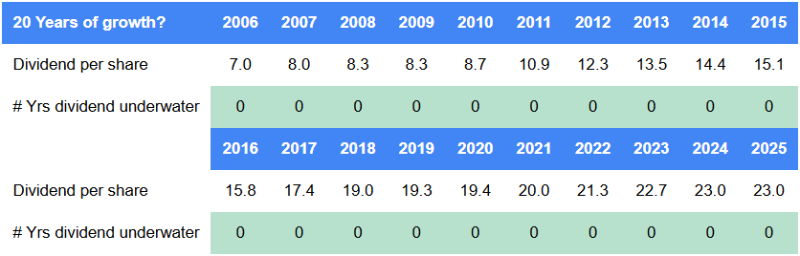
While Bodycote did manage to maintain or grow its dividend throughout the last ten years, progress across revenues, earnings and shareholder equity has been less impressive.
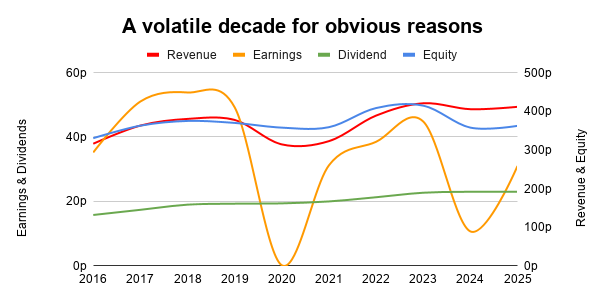
The pandemic was, of course, the main reason for this lack of consistent growth.
Bodycote’s earnings were decimated in 2020, and supply chain issues and a general sense of caution have weighed heavily on economic progress ever since. In 2024, the combination of a botched software project and the closure of several non-core plants led to another year of very weak profits.
All of that gives Bodycote a ten-year growth rate (averaged across equity, revenues and dividends) of 2%, which is below inflation and below my minimum target of 3%.
Profitability has only been mediocre
When Bodycote joined my portfolio in 2020, its ten-year average net return on capital was above my minimum threshold of 10%.
However, over the ensuing years, I’ve learned that mediocre businesses can occasionally get lucky and generate above average results over a single ten-year period, so I now look for above average results over 20 years.
On that basis, Bodycote’s profitability record comes up short, as shown in the table below (which shows the rolling ten-year average net return on capital over the last ten years).
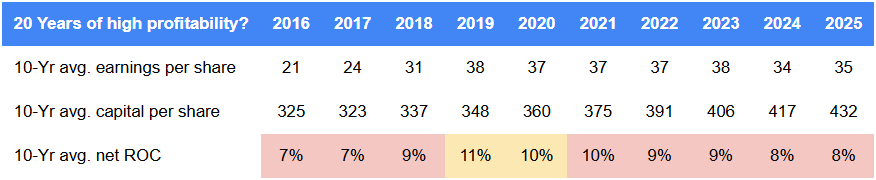
Bodycote only achieved an acceptable average net return on capital in 2019 and 2020, just at the time when I reviewed the company and purchased its shares.
Over the whole 20-year period, Bodycote generated average net returns on capital of just 7%. That isn’t terrible, but it isn’t great either and it’s below my minimum threshold of 10%.
This suggests that Bodycote’s competitive advantages (which it does have) are relatively weak, giving the company little ability to raise prices or lower costs more than its peers.
Cash flows are at risk from high capital intensity
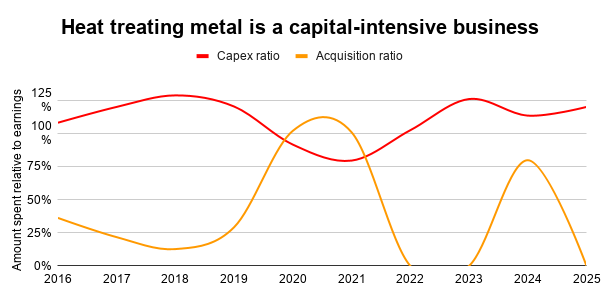
Heat treating metals on an industrial scale is an expensive business, with some pieces of equipment (such as large Hot Isostatic Presses) costing upwards of £20 million. This can be a barrier to entry for smaller competitors, which is good if you’re the biggest fish in the pond (as Bodycote is), but it’s expensive, nonetheless.
In Bodycote’s case, the ratio of total capex to total earnings over the last ten years is currently 111%, so it spent slightly more on capex than it earned in profit. That is a potential problem because (thanks to the rules of accrual accounting) large capital expenses can cause large gaps between profits and cash generation, and dividends are (or at least, should be) paid out of surplus cash.
This high capital intensity doesn’t make Bodycote a bad business, but it does make growth expensive, and it does divert cash away from dividends. Both of those are problems that a bad management team might try to solve by taking on too much debt.
Large acquisitions can also be a drain on cash, as well as being operationally and culturally disruptive. Fortunately, Bodycote only spent 38% of its earnings on acquisitions over the last ten years, and that’s comfortably below the 50% mark where my eyebrows begin to rise.
Bodycote has a focused core business with durable competitive advantages
High-quality companies are usually built around a stable, focused, market-leading core business that has at least one durable competitive advantage.
A world leader in metallurgical treatments
Bodycote is the world leader in metallurgical treatments, which involve the application of heat, pressure and coatings to improve the functional properties of metal components. Without these processes, the modern industrial world would be simply impossible.
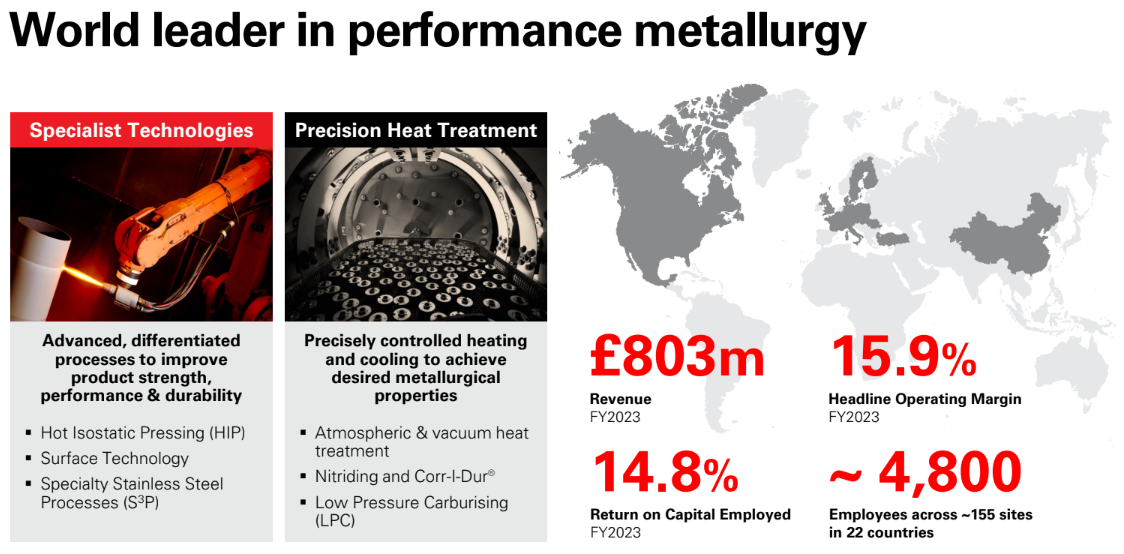
Metallurgical treatments effectively generate 100% of Bodycote’s revenues, and those treatments are split into two groups, which make up its two divisions:
Precision Heat Treatment (71% of 2025 revenue): This division is the world leader in classical heat treatments, which covers a wide range of traditional heat treatments used to improve the functional properties of metal components.
Unfortunately, this division’s revenues have fallen by an average of 2% per year over the last decade, mostly because the low end of the market has become commoditised and low-cost competitors are taking market share. To offset this, Bodycote has gradually tilted this division towards high-precision treatments, where technical complexity locks out generic low-cost competitors, and where quality and reliability are at least as important as price.
Specialist Technologies (29% of 2025 revenue): This division is the world leader in “specialist technologies”, which are a group of relatively new and technically advanced treatments that are still scaling up as customer awareness and acceptance increases.
When it comes to specialist technologies, Hot Isostatic Presses (HIPs) are my usual go-to example, as the numbers are impressive: Large presses can cost upwards of £20 million and they run at temperatures of around 2,000 degrees centigrade. They can also apply up to 3,000 bar of pressure, which is about three-times the pressure you’d feel (in the nanosecond before you died) at the bottom of the Mariana Trench.
HIPs apply that heat and pressure to turn fabricated components into 100% solid metal, squeezing out imperfections that are an inherent part of welding, casting and additive manufacturing.
This division’s revenue has grown at a compound rate of 4% over the last decade, with profit margins significantly higher than those of the larger Precision Heat Treatment division.
A consistent and sensible growth strategy
Bodycote has had broadly the same growth strategy since 2009. Before that, the company was focused on building world-leading scale by acquiring smaller competitors and integrating them into a network that peaked at almost 200 plants.
However, like many acquisition-built companies, Bodycote suffered from complexity, duplication and a lack of operational standardisation, so margins, profits and cash generation were weak.
In 2009, the strategy was updated and it remains broadly the same today, with two main goals:
- Improve the quality of Classical/Precision Heat Treatment
Since 2009, the Precision Heat Treatment division (which used to be called Classical Heat Treatment) has been closing or selling its weakest plants and rolling out best-practice operational blueprints for the remaining plants. The aim is to improve profit margins and win contracts for work that is more demanding, more value-adding and less commoditised.
In practice, this often means becoming embedded within the supply chains of large Western manufacturers, in high-stakes industries such as aerospace, automotive and oil & gas (where quality and reliability matter more than price).
This quality-over-quantity strategy has reduced Bodycote’s network from around 200 plants to about 135 today, but profitability has improved significantly, and further improvements remain a key priority.
- Increase the demand for and supply of Specialist Technologies
Specialist Technologies are expensive, new or proprietary metallurgical treatments that are either superior to classical treatments or provide functional properties that classical treatments simply cannot replicate.
This makes them highly profitable, but also niche, so Bodycote has spent the last few decades trying to increase demand and supply, by raising customer awareness and acceptance while building or buying the necessary facilities to meet growing demand.
Thanks to this focus and the inherent superiority of the various technologies, the Specialist Technologies division has grown from 14% of Bodycote’s revenues in 2007 to 29% today. It has powered essentially all of Bodycote’s growth over the last decade and it now generates almost half of the company’s overall profit, which bodes well for the future.
Durable competitive advantages from scale and breadth
Bodycote’s main competitive advantage comes from the sheer size of the business. It currently has about a 15% share of the outsourced heat-treatment market, which is at least double its nearest competitor. It’s also the world-leader across a broad array of treatments, from hot isostatic presses to specialist stainless steel coatings.
Being the dominant market leader gives Bodycote a range of advantages, including:
- A powerful sales tool, as many companies like buying from the market leader
- More data from which to develop and disseminate best practices
- Denser networks of local plants, which allows each plant in the network to specialise on (and be more efficient at delivering) a smaller subset of treatments
- A larger R&D budget to develop new heat/surface treatments and optimise old treatments
- A global footprint to satisfy the needs of global tier-1 manufacturers like Rolls-Royce
- The ability to invest £60mn+ in a new hot isostatic press facility, and to significantly speed up the usual 3-year ramp-up period by diverting work from its nearby HIP facilities into the new facility, which massively reduces the usual 20-year breakeven period
As well as market-leading scale, Bodycote also has industry-leading horizontal integration. In other words, Bodycote is the only truly global outsourced metallurgical treatment business, and it offers the widest range of heat/surface treatments, including classical heat treatments, specialist stainless steel processes, hot isostatic pressing and a wide array of specialist surface treatments.
All of that makes it uniquely attractive as a one-stop-shop for global tier-1 manufacturers and their supply chains, and that is a hard-to-replicate (and therefore durable) advantage.
Bodycote has reasonable prospects for long-term growth
Humans have been heat-treating metals for thousands of years, so despite the rise of various high-performance non-metallic materials, the heat/surface treatment markets are expected to continue growing with the global economy (at around 3%).
In addition, Bodycote is focused on specific markets with higher expected growth rates, such as medical devices, aerospace & defence and energy, and its Specialist Technologies division is expected to grow materially ahead of the broader market over at least the medium term.
Along with overall market growth, Bodycote also has a long history of expanding into closely related adjacent markets, either through organic growth or acquisition, and this process continues today.
For example, in 2024, Bodycote acquired Lake City HT, expanding the company’s geographical footprint into Indiana and increasing its HIP capacity in the medical device market. And in 2026, it invested $30 million into new and expanded facilities in Ohio, to support the growing US aerospace sector.
Bodycote’s valuation isn’t as attractive as it used to be
No company is worth an infinite price, so regardless of a company’s quality, its share price and dividend yield must still be attractive.
Bodycote’s dividend yield is now below average
When the takeover offer was announced in August, Bodycote’s share price jumped from around £7.25 to around £9.10. That leap was good for capital gains, but it also reduced Bodycote’s dividend yield to 2.5%. That’s below the FTSE All-Share’s 3.1% yield, and that’s a problem because one of my portfolio’s main goals is to have a higher yield than the All-Share.
The share price is above my fair value estimate
Although a stock’s dividend yield is important, it’s less important than whether the shares are trading above or below their intrinsic or fair value.
Investors differ in how they estimate fair value. Most use the PE ratio as a simple proxy, while some dividend investors (including me) estimate a stock’s fair value using discounted dividend models.
In other words, I estimate a stock’s future cash returns to shareholders, from dividends and the eventual sale of the shares, and then calculate what those future cash flows might be worth today.
My fair value estimates are typically based upon a handful of conservative yet realistic assumptions, and for Bodycote these are:
- Due to recent improvements in Bodycote's operational efficiency, net return on capital increases to 10%, which is above the 10-year average of 8%
- Dividend cover is kept at a historically average 1.3 (this includes cash previously returned to shareholders through special dividends and buybacks)
- This retains enough earnings to fund a growth rate of just over 2%
- The shares are sold in 2035 at a historically average PE of 21, giving an exit share price of £11.72
- The discount rate is set at 7% (in other words, if purchased at fair value, the shares would return 7% annualised; this is "fair" because 7% is the UK market’s long-term average return)
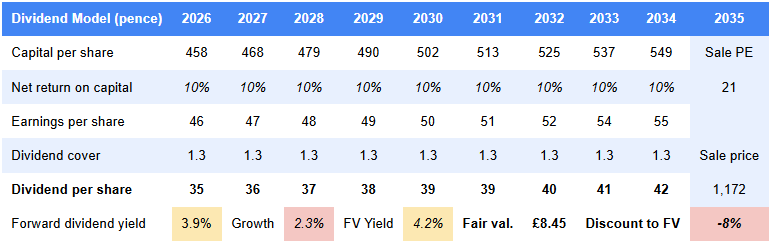
This model gives Bodycote an estimated fair value of £8.45 per share, which is below the current share price (at the time of writing) of £9.10. That, in turn, means that Bodycote is now trading at an 8% premium to my fair value estimate.
Given that the shares are trading above my estimate of fair value, and the dividend yield is below the market average, and there’s an impending takeover, holding on to Bodycote makes little sense.
That, in a nutshell, is why I sold it on October 6th at £9.10 per share.
A successful investment, cut short by yet another takeover
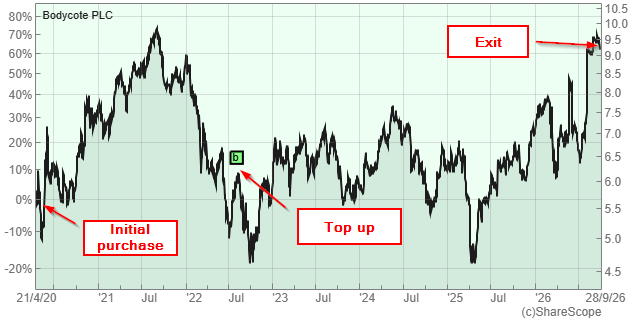
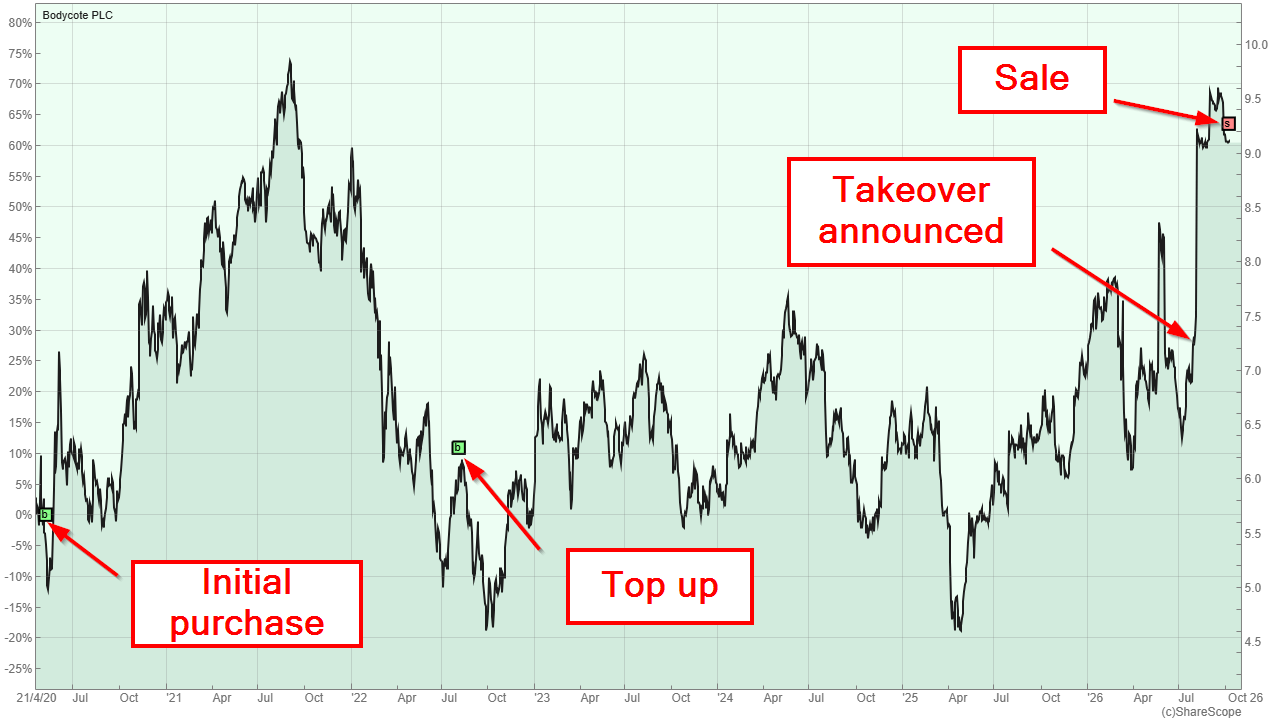
Chart by ShareScope
Bodycote joined the UK Dividend Stocks portfolio in May 2020, at £5.65 per share. It started out as a relatively small position due to cash constraints at the time, so when the share price fell back to appealing levels in mid-2022, I topped it up at £6.14 per share.
With the investment now sold at £9.10 per share, the final results are:
- Holding period: 6.4 years
- Return from dividends: 21% (avg. 3.3% per year)
- Capital gain: 53% (avg. 8.3% per year)
- Total return: 74% (avg. 11.6% per year)
- Annualised total return: 11.7%
Overall, I’m pleased with this investment. I now see Bodycote as a somewhat borderline case in terms of quality, but it’s definitely a good business, and when combined with a reasonably attractive purchase price, good is sometimes good enough.
Following Bodycote’s sale, the UK Dividend Stocks portfolio now has a cash balance of more than 10%, so I expect to reinvest most of that into a new holding next month.
No time for spreadsheets or annual reports?
If you like this article but don’t have hours each month to dig through company accounts, you might find my monthly investment newsletter useful.
Once a month I send out a plain‑English PDF showing:
- The full UK dividend stocks model portfolio
- Which shares I’m buying, selling, trimming or topping up
- The latest news and trading updates for each holding
- Where we are in the stock market valuation cycle
All designed so a UK investor can stay on top of their dividend portfolio in well under an hour a month.
Get the latest blog posts & a free checklist
Get my latest articles in (at most) one email per week and download my dividend investing checklist. Topics usually include:
- Detailed reviews of high-quality UK dividend stocks
- Updates on my UK dividend stocks portfolio
- FTSE 100 and FTSE 250 valuations
- "How to" articles covering all aspects of dividend investing
No spam. Unsubscribe anytime.